
Displaying 1 to 30 of 88

Supporting workers with long covid (PNG, 24 Kb, 292x357)
Long COVID is a complex syndrome that affects many people previously infected with COVID-19. It has major implications for the workforce, contributing to sickness absence, impaired productivity and job loss. Karina Nielsen and Jo Yarker explain how a framework that combines support from managers, occupational...

An integrated approach to managing wellbeing in the workplace (PNG, 242 Kb, 390x602)
An integrated approach to managing wellbeing in the workplace
Tue, 23 Jul 2024
Edward Elgar Publishing
Mental health presents a major challenge in the modern workplace, and COVID-19 exacerbated this challenge. In this chapter, we propose the Integrated Organizational Mental Health Resilience Framework, a framework that outlines the steps needed for organizations to develop resilience against turbulence....

Working Patterns and Wellbeing (PNG, 242 Kb, 390x602)
This chapter discusses research on factors impacting wellbeing for three groups of employees with very different working patterns: business travellers, remote rotational workers, and hybrid workers. The chapter presents three studies, conducted with global samples between 2018 and 2021, which explored...

Webinar - It’s a rollercoaster – long COVID workers’ lived experiences adjusting to work
Webinar - It’s a rollercoaster – long COVID workers’ lived experiences adjusting to work
Fri, 12 Jul 2024
Click here to watch our webinar in collaboration with the Society of Occupational Medicine about long COVID workers' lived experiences adjusting to work.
If you want to find out more about working with long COVID, have a look at our guides with CIPD:
- Working with long COVID - guide for employees
- Working...

Increasing workforce psychological flexibility through organization-wide training: Influence on stress resilience, job burnout, and performance (PDF, 971 Kb)
Increasing workforce psychological flexibility through organization-wide training: Influence on stress resilience, job burnout, and performance
Tue, 2 Jul 2024
Journal of Contextual Behavioural Science
There is growing interest in the role of psychological flexibility as a potential resilience factor in workplace settings for protecting employees against the risk of job burnout. This field study contributes to the literature by investigating the utility of delivering brief ACT-informed training to...

“It’s Business”: A Qualitative Study of Moral Injury in Business Settings; Experiences, Outcomes and Protecting and Exacerbating Factors (PDF, 804 Kb)
“It’s Business”: A Qualitative Study of Moral Injury in Business Settings; Experiences, Outcomes and Protecting and Exacerbating Factors
Sun, 11 Feb 2024
Journal of Business Ethics
Moral injury has primarily been studied from a clinical perspective to assess, diagnose and treat the outcomes of morally injurious experiences in healthcare and military settings. Little is known about the lived experiences of those who have had their moral values transgressed in business settings....

The business case for investing in health and wellbeing (PDF, 708 Kb)
The business case for investing in health and wellbeing
Thu, 8 Feb 2024
Taking an integrated approach to mental health and wellbeing brings gains to health, performance and retention. We provide a summary of the latest research and share cost calculations you can use to estimate the overall cost of poor mental health in your organisation. Our review shows that investing...

Protocol for a pilot cluster randomised controlled trial of a multicomponent sustainable return to work IGLOo intervention (PDF, 4.4 Mb)
Protocol for a pilot cluster randomised controlled trial of a multicomponent sustainable return to work IGLOo intervention
Sat, 3 Feb 2024
Pilot and Feasibility Studies
Long-term sickness costs businesses in the United Kingdom (UK) approximately £7 billion per annum. Most long-term sickness absences are attributed to common mental health conditions, which are also highly prevalent in people with acute or musculoskeletal health conditions. This study will pilot...

Using technology responsibly to manage people - A series of guides on how people professionals can lead on the responsible use of technology within organisations
Tue, 30 Jan 2024
Chartered Institute of Personnel and Development
Each guide focussed on the common uses of technology, as well as the benefits and risks across six key Human Resource areas:
- Recruitment and workforce planning
- Performance management
- Employee wellbeing
- Employee voice
- Learning and development
- Equality, diversity and inclusion
Through literature review, interviews...

Developing a competency framework for integrated care working (PDF, 199 Kb)
Developing a competency framework for integrated care working
Fri, 5 Jan 2024
British Journal of Healthcare Management
In July 2022, a statutory requirement for all NHS and social care systems to be organised into integrated care systems came into effect. Integrated care systems are partnerships that bring together healthcare, local government and other agencies to collectively manage service planning, improve health...
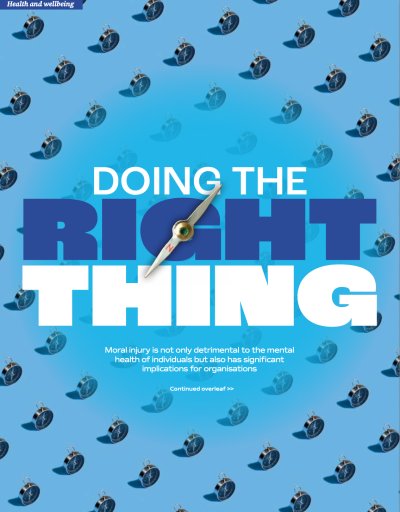
Moral Injury - Doing the right thing (PDF, 313 Kb)
Moral Injury - Doing the right thing
Sat, 23 Dec 2023
"Moral injury is not only detrimental to the mental health of individuals but also has significant implications for organisations"
The majority of research into moral injury has been focused on high-risk sectors such as the military, emergency services and healthcare sectors, so we recently conducted...
The recovery and return to work experiences of workers with long COVID (PDF, 865 Kb)
The recovery and return to work experiences of workers with long COVID
Fri, 24 Nov 2023
Work & Stress, International Journal of Work, Health & Organisations. Taylor and Francis Online
The severity and longevity of long COVID that has also affected the working population, raises the important question, how organisations can support workers with long COVID to stay and thrive in the workplace. In the present study, we used Interpretative Phenomenological Analysis to explore the lived...
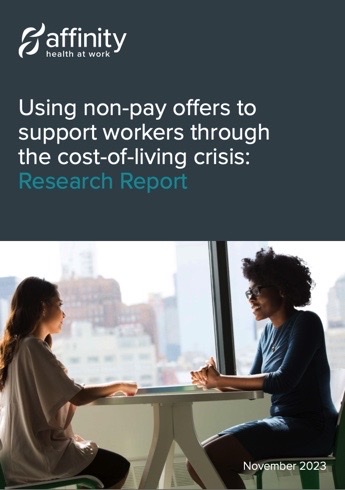
Supporting employees with non-pay offers through the cost-of-living crisis (PDF, 1.4 Mb)
Supporting employees with non-pay offers through the cost-of-living crisis
Wed, 8 Nov 2023
Affinity Health at Work
The 'cost-of-living crisis', defined as the fall in 'real' disposable income that the UK has been experiencing since late 2021 is having a profound impact on the nation. Inflation reached a 40 year high in October 2022 (ONS, 2022a) and the fiscal year 2022-23 saw the biggest one-year fall in living standards...

Digital Training Program for Line Managers (Managing Minds at Work): Protocol for a Feasibility Pilot Cluster Randomized Controlled Trial
Tue, 24 Oct 2023
JMIR Publications
Line managers hold a primary role in preventing poor mental health within the workplace and, therefore, need to be equipped with the skills and knowledge to effectively carry out this role. The Managing Minds at Work (MMW) intervention aims to increase line managers' knowledge and confidence in preventing...

Coaching culture: an evidence review and framework for future research and practice
Coaching culture: an evidence review and framework for future research and practice
Wed, 30 Aug 2023
Taylor & Francis
Given the colossal interest in creating 'coaching cultures', we update the 2014 literature review by Gormley and van Nieuwerburgh and extend this work by applying a Systematic Literature Review (SLR) methodology. In doing so, we detangle definitions and the conditions under which 'coaching cultures'...
Outcomes of Senior Leadership Disclosure of Mental Health Lived Experience
Speaking out on mental health and 'leading by example' is often easier said than done. For those who consider share their experience, the worries round vulnerability, stigma and being judged have historically often been justified. This report examines the research evidence on the outcomes of senior leader...

Thrivers, survivors or exiteers: A longitudinal, interpretative phenomenological analysis of the post‐return‐to‐work journeys for workers with common mental disorders
Thu, 18 May 2023
Wiley
The research on return to work for workers with common mental disorders has primarily focused on the pre-return journey. Relapses and recurrent sick leaves are prevalent and call for research on how we can support workers stay and thrive at work after long-term sickness absence due to common mental disorders....

Work fatigue during COVID-19 lockdown teleworking: the role of psychosocial, environmental, and social working conditions
Thu, 18 May 2023
Frontiers
During national lockdowns in response to the COVID-19 pandemic, previously office-based workers who transitioned to home-based teleworking faced additional demands (e.g., childcare, inadequate homeworking spaces) likely resulting in poor work privacy fit. Previous office research suggests poor work privacy...

Introduction to the Working Well Maturity Framework (PDF, 1.1 Mb)
Introduction to the Working Well Maturity Framework
Tue, 11 Apr 2023
The rapid increase in the number of wellbeing frameworks available has given rise to a bewildering choice for organisations. The Working Well Maturity Framework was developed in response to calls from Affinity's Research Consortium, to develop a clear picture on how frameworks differ and to develop a...
Meta-synthesis of qualitative research on the barriers and facilitators to implementing workplace mental health interventions
Mon, 26 Dec 2022
SSM-Mental Health
Purpose: There has been a rapid increase in the number of mental health interventions implemented in the
workplace. The efficacy of these interventions has been mixed. The factors influencing implementation may offer
insights to why some interventions fail to be effective.
Method: We conducted a meta-synthesis...

Digital Mindsets Summary Report (PDF, 120 Kb)
Digital Mindsets Summary Report
Wed, 14 Dec 2022
The Digital Mindsets project aims to develop our understanding of people's attitudes and beliefs regarding technology and change in the workplace (their digital mindset) and use this understanding to help support people through change, thus ensuring a more inclusive workplace.
Affinity Health at Work...
Employees' experience of supervisor behaviour - a support or a hindrance on their return-to-work journey with a CMD? A qualitative study
Mon, 14 Nov 2022
Work & Stress, International Journal of Work, Health & Organisations. Taylor and Francis Online
Supervisors play an important role in supporting employees to return to work following sickness absence due to common mental disorders; stress, anxiety and depression, however, employees may not always feel supported. We examined employees' perceptions of their supervisors' attitudes and behaviours pre,...

Managing duty of care for wellbeing within a hybrid workforce (PDF, 1.7 Mb)
Managing duty of care for wellbeing within a hybrid workforce
Tue, 1 Nov 2022
International SOS Foundation
Remote working has become increasingly common in the modern workforce, hugely accelerated by the COVID-19 pandemic, meaning that support for wellbeing in organisations has had to adapt to a new context. The aim of this research, carried out by Affinity Health at Work on behalf of the International SOS...

"What can I do for you? Line managers' behaviours to support return to work for workers with common mental disorders"
Tue, 4 Oct 2022
Journal of Managerial Psychology
| Sustainable return to work remains challenging for workers returning after long-term sick leave due to common mental disorders (CMDs): stress, anxiety and depression. Line managers play a significant role in supporting returned workers. Therefore, the purpose of this qualitative study was to examine... |
Physical Workplace Adjustments to Support Neurodivergent Workers: A Systematic Review
Physical Workplace Adjustments to Support Neurodivergent Workers: A Systematic Review
Tue, 6 Sep 2022
IAAP - International Association of Applied Psychology
This review examined the extent, nature and quality of the current empirical evidence for physical workplace adjustment to support occupational longevity, performance and health/well-being in ND workers because of their specific sensory needs. Our results indicate that the research is generally not well-developed,...

Long COVID and Return to Work - What Works? A position paper from the Society of Occupational Medicine (PDF, 685 Kb)
Long COVID and Return to Work - What Works? A position paper from the Society of Occupational Medicine
Thu, 4 Aug 2022
Society of Occupational Medicine
This paper provides guidance on the identification and management of Long COVID - particularly regarding return to work. This guidance has been produced by members of The Society of Occupational Medicine Long COVID Group, of which our Managing Partner Jo Yarker is a member, and other work and health...
Managing Minds at Work: Development of a Digital Line Manager Training Program (PNG, 496 Kb, 1130x1604)
Mental ill-health is the leading cause of sickness absence, creating a high economic burden. Workplace interventions aimed at supporting employers in the prevention of mental ill-health in the workforce are urgently required. Managing Minds at Work is a digital intervention aimed at supporting line managers...

Your Job Can Be Good For You (PDF, 5 Mb)
We were pleased to be BITC's research partner to create the 'Your Job Can Be Good For You' report which sets out how businesses can revolutionise the way employees work while supporting broader responsible business goals. It also includes recommendations to begin post-pandemic re-sets of employee wellbeing...

Developing an Understanding of Moral Injury in Business Settings Summary (PDF, 240 Kb)
Developing an Understanding of Moral Injury in Business Settings Summary
Mon, 30 May 2022
Affinity Health at Work
Moral injury refers to the lasting strong cognitive and emotional response that is caused by performing, witnessing, or failing to prevent an action that violates one's own moral beliefs and expectations (Litz et al., 2009; 2019). Typically, moral injury research has been conducted within military settings,... |

Developing an Understanding of Moral Injury in Business Settings (PDF, 584 Kb)
Developing an Understanding of Moral Injury in Business Settings
Mon, 30 May 2022
Affinity Health at Work
Moral injury refers to the lasting strong cognitive and emotional response that is caused by performing, witnessing, or failing to prevent an action that violates one's own moral beliefs and expectations (Litz et al., 2009; 2019). Typically, moral injury research has been conducted within military settings,... |